UV flatbed vs. UV DTF vs. hybrid UV: which printer should a shop buy first?
A serious platform comparison for sign shops, promo sellers and custom product businesses deciding whether the first UV machine should be flatbed, UV DTF, hybrid or roll-to-roll.
The first UV machine creates the business you will run
The platform map is a first filter. Final selection depends on size, throughput, ink set and service plan.
Many buyers ask, 'Which UV printer is best?' The better question is, 'Which UV business do I want to build first?' A flatbed business, a UV DTF business, a hybrid sign business and a roll-to-roll business have different customers, workflows, margins and maintenance habits. They may all use UV ink, but they do not sell the same promise.
A UV flatbed sells direct-to-substrate control. It puts ink, white and varnish directly on acrylic, wood, glass, metal, PVC, foam board, packaging blanks, plaques and product surfaces. A UV DTF system sells transfers. It prints on film, laminates adhesive and lets the shop decorate irregular hard goods that are difficult to fixture. A hybrid UV printer sells flexibility across roll media and boards. A roll-to-roll machine sells continuous wide-format production. The buyer should not choose by brochure excitement. The buyer should choose by the order book they can feed.
The first machine matters because it shapes marketing, operator training, shop layout, consumables and customer expectations. If you buy flatbed, you will learn fixtures, bed loading and substrate adhesion. If you buy UV DTF, you will learn film, lamination, transfer pressure and product surfaces. If you buy hybrid, you will manage more floor space, material handling and workflow complexity. The right answer is the platform that turns existing demand into profitable in-house work fastest.
UV flatbed: the most versatile first machine for rigid products
A UV flatbed is usually the broadest first machine for a shop that wants to print rigid products. It can produce acrylic signs, glass panels, wood boards, metal tags, trophy plates, retail displays, sample packaging, ADA-style signage, product blanks, foam board and many short-run promotional products. White ink and varnish effects make the same machine useful for premium work instead of only commodity flat prints.
Flatbeds are powerful because they turn local objects into local revenue. A customer brings a product, a plaque, a board or a panel, and the shop can print directly on it. This creates fast turnaround and avoids the delay of outsourcing. It also lets the shop build repeatable products with jigs. Once a fixture is made for a badge, golf accessory, award plate or small panel, repeat orders become faster and more profitable.
The limitation is that flatbed printing rewards preparation. The operator must control object height, flatness, adhesion, alignment and handling. Heavy boards require space. Irregular objects may need custom fixtures or may be better served by UV DTF. Large roll jobs may be inefficient unless the shop buys hybrid capability. For many buyers, however, flatbed is the strongest first platform because it covers the widest profitable product mix.
Best products
Profit lever
Operational requirement
Acrylic signs and plaques
Premium finish, white ink, mounting hardware
Clean edges, careful handling, adhesion testing
Awards and nameplates
Repeatable jigs and small-batch personalization
Accurate placement and template discipline
Wood and cornhole tops
Large ticket orders and local customization
Board handling, coating and finishing
Packaging prototypes
Fast mockups without outsourcing
Color control and material flatness
Metal and glass
High perceived value
Primer/adhesion validation
UV DTF: the fastest path into irregular hard goods
UV DTF is strongest when the object is hard to fixture or the shop needs many small graphics batched together.
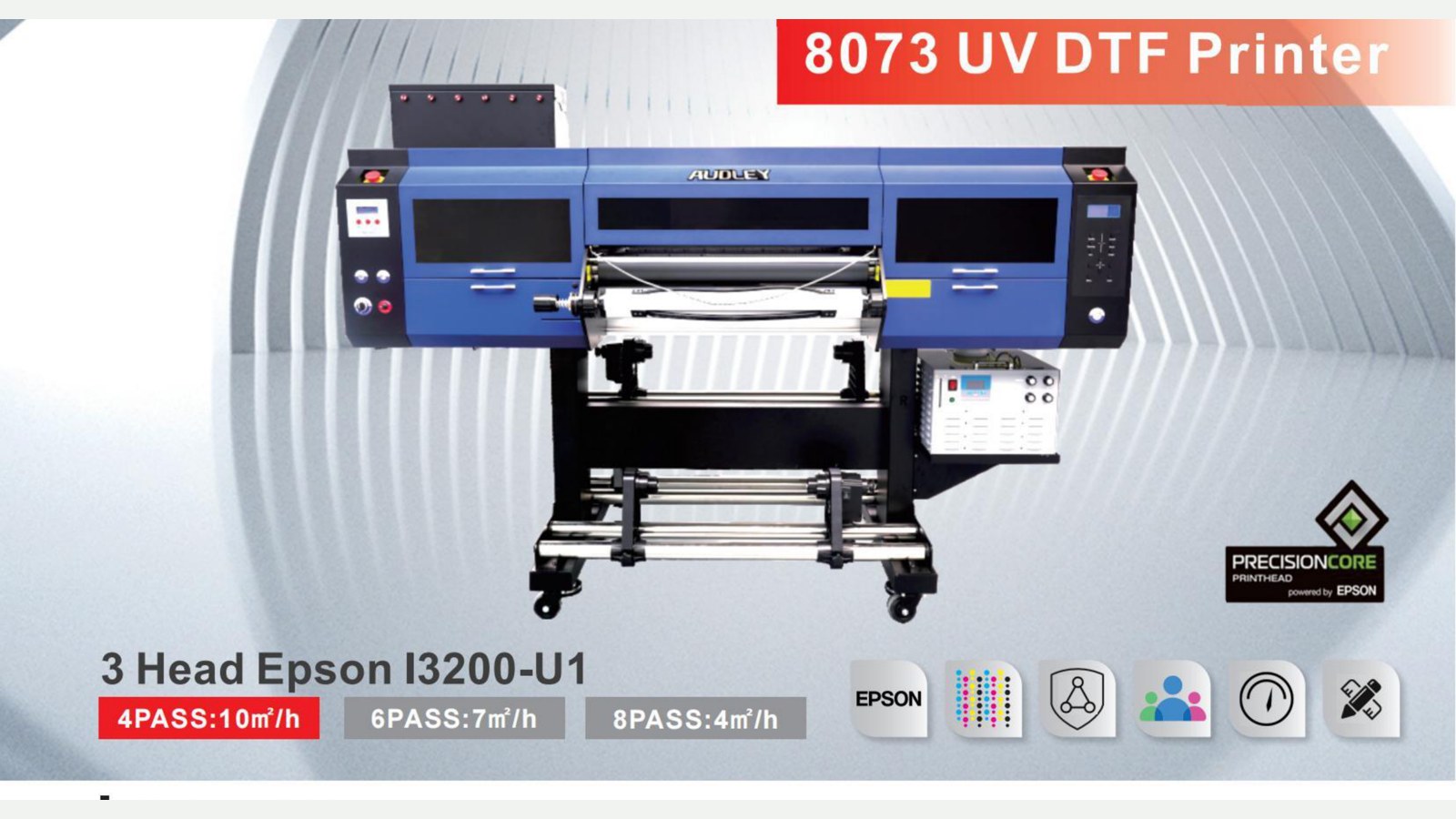
UV DTF has grown because many products are annoying to print directly. Tumblers, bottles, helmets, cosmetic containers, electronics, curved promotional products and textured hard goods can be slow to fixture on a flatbed. UV DTF changes the workflow. The printer produces a transfer on film, the transfer is laminated, and the finished graphic is applied to the product. This can make short-run decoration faster and more flexible.
The business case is attractive for sellers who want product variety. A shop can sell drinkware wraps, small labels, brand stickers, packaging decorations, event merchandise and online personalized hard goods without building a custom jig for every object. The customer sees a durable, raised, glossy graphic. The shop sees a workflow that can batch print many designs before application.
The economics must include film and adhesive, not only ink. UV DTF consumables can be a meaningful part of cost per job. Application labor also matters. If a seller prices transfers like simple stickers, margin disappears. If the seller positions them as premium durable decoration for hard goods, UV DTF can create strong contribution with relatively low machine capex.
Hybrid UV: one platform for boards and rolls
Hybrid UV printers make sense for sign shops that live between rigid boards and flexible roll media. A pure flatbed is strong for boards but not ideal for continuous banners, wallcovering or roll film. A pure roll printer is efficient for flexible media but does not directly print thick rigid panels. Hybrid UV tries to bridge that gap. It can reduce the need for two machines, but it also requires more floor space and stronger operator discipline.
The best hybrid buyer already has sign demand. They print foam board, PVC, acrylic, banners, vinyl, film, wall graphics and retail displays. They understand file preparation, finishing and material handling. For that buyer, a hybrid system can consolidate workflow and expand what the shop quotes. It may also be a better first UV choice than a smaller flatbed if board and roll jobs already exist.
The risk is buying hybrid flexibility without enough volume. A hybrid machine can be larger, more complex and more expensive than a focused flatbed or roll system. If the shop mostly sells small objects or occasional signs, hybrid may be overkill. If the shop already outsources boards and banners every week, hybrid may be the most strategic purchase.
Question
If yes
If no
Do you already sell boards and roll media?
Hybrid deserves serious evaluation.
Start with flatbed or UV DTF instead.
Do you have floor space and material handling?
Hybrid workflow can be efficient.
A smaller flatbed may be safer.
Do you need one operator to run mixed signage?
Hybrid can consolidate production.
Separate machines may be easier to manage.
Is monthly volume predictable?
The capex can be justified.
Wait until demand is repeatable.
Roll-to-roll: still essential for continuous media
Roll-to-roll wide-format printers remain essential for banners, posters, vinyl, wall graphics, film, decals and continuous production. Not every shop needs UV roll-to-roll specifically; eco-solvent, latex, sublimation and other ink sets may fit different applications. But if the shop's revenue is mostly flexible media, a roll workflow is usually more efficient than forcing roll jobs through a flatbed mindset.
A roll machine can be the right first purchase for a sign shop that does not need rigid direct print yet. It can also sit beside a flatbed or UV DTF machine as part of a complete production room. The economic question is whether roll jobs are frequent enough to keep the machine busy. Continuous media rewards volume and batching. If the shop only occasionally prints vinyl, outsourcing may still be rational until demand grows.
In the Epson.Press catalog, roll-to-roll systems are included because many buyers start with flatbed interest but also need banners, posters or wall graphics. The final recommendation depends on the product mix. Sometimes the best answer is a roll printer first, then flatbed. Sometimes it is flatbed first, then roll. Sometimes hybrid is better than buying both.
Payback comparison by product type
The payback curve changes by product. A $20 drinkware wrap, a $70 acrylic sign, a $300 cornhole set and a $45 award do not recover machine cost at the same speed. The shop should model contribution per job, realistic monthly volume, reject rate, advertising and maintenance. This is why Epson.Press added a calculator instead of only listing printer prices.
A UV DTF seller may recover a smaller machine quickly if they can sell hundreds of wraps per month with a repeatable application workflow. A flatbed owner may recover through fewer jobs if the average ticket is higher. A hybrid sign shop may need more total revenue but can pull from several categories. The printer price is only one variable. Product selection decides the math.
The safest first machine is often the one with the broadest near-term product plan. If a shop already has business customers asking for signs, plaques and branded hard goods, flatbed may be first. If the shop has an online audience for tumblers and stickers, UV DTF may be first. If the shop already sells signs, hybrid may be first. If the shop only has curiosity, start smaller and prove demand.
Platform
Typical first revenue
Payback driver
Common mistake
UV flatbed
Acrylic, awards, panels, signs, samples
Higher average ticket and broad material range
Underestimating fixtures and adhesion testing
UV DTF
Drinkware, hard-good transfers, labels
Volume and product variety
Ignoring film, adhesive and application labor
Hybrid UV
Boards plus roll media
Existing sign demand across material types
Buying flexibility before demand exists
Roll-to-roll
Banners, wall graphics, decals, film
Continuous production and repeat media
Using it for products that need rigid direct print
What service looks like for each platform
Every UV platform needs maintenance, but the pain points differ. Flatbeds need bed cleanliness, vacuum or fixture control, head height discipline and careful handling of rigid substrates. UV DTF systems need film path control, lamination consistency, white/varnish stability and transfer application discipline. Hybrid systems need both rigid and roll handling habits. Roll printers need media feed stability, take-up control, head care and environmental consistency.
The service conversation should happen before the crate ships. Where will the machine sit? What power is available? How will heavy boards be lifted? Who performs daily nozzle checks? What spare parts ship with the printer? What ink and cleaning fluid will be stocked? What is the shutdown routine if the machine is idle for several days? What products will be tested first? These questions prevent expensive surprises.
Epson-head factory-direct equipment is attractive partly because routine parts can be more accessible and the owner can learn the machine. That is an advantage only if the supplier and buyer document the workflow. The easier a machine is to service, the more valuable it becomes to a small business.
How to decide in 15 minutes
List the products you can sell in the next 90 days. Do not list every product the internet says is possible. List what your customers, audience or sales team can actually move. Then mark each product as flat, curved, flexible, rigid, large, small, repeatable or one-off. The pattern will usually point toward one platform.
If most products are rigid and flat, choose UV flatbed. If most products are curved or hard to hold, choose UV DTF or cylinder UV. If most products are sign panels and roll media, choose hybrid or a roll-plus-flatbed plan. If most products are flexible rolls, choose roll-to-roll. If the product list is still vague, do not overbuy. Use a smaller machine, samples or outsourced production until demand becomes clearer.
Flat products: UV flatbed first.
Irregular hard goods: UV DTF or cylinder UV first.
Mixed sign work: hybrid UV or roll plus flatbed.
Continuous flexible media: roll-to-roll first.
Unproven demand: smaller validation machine or outsourced samples first.
The Epson.Press recommendation philosophy
We would rather sell the machine that matches the work than the machine that looks most impressive in a catalog. A first UV purchase should create momentum. The owner should be able to photograph products, quote jobs, ship orders, learn maintenance and see the payback path. That may mean a compact UV flatbed. It may mean I3200 production. It may mean UV DTF. It may mean a hybrid platform. The right answer depends on the product mix.
The best first machine makes the next machine easier to buy. If a UV DTF system proves demand for decorated hard goods, the shop can add flatbed later. If a flatbed proves demand for acrylic and signage, the shop can add roll or hybrid later. If a roll printer proves banner and wall graphics volume, the shop can add rigid UV later. The goal is not to own the biggest printer. The goal is to own the revenue that justifies the next move.